

Connected Region Challenge
A Wallet. A Tap. From Guest Card to Regional Ecosystem.

Less Formalities, More Austria
This challenge invites you to help design the Card Ökosystem 2030 — a digital card system for Burgenland that serves guests, residents, local partners, and the region, beyond today’s guest card.
Anyone vacationing in Austria faces a fragmented experience: re-identifying at every touchpoint, registering anew, paying separately. Systems work individually but remain disconnected, placing the burden of coordination on guests. This is about to change.
By the end of 2026, every EU member state must provide a European Digital Identity Wallet (EUDI Wallet). Austria is already well-positioned with ID Austria. Travelers — and residents — will soon carry verified identity data on their smartphones, sharing only what’s needed, when it’s needed, with full control. This is no longer a distant vision — after more than a decade of groundwork, the infrastructure is arriving in production — and Austrian tourism has a narrow window to be among the first to shape what it enables.
When Formalities Interrupt the Journey
A family from the Netherlands arrives at a small pension near Neusiedler See after a long train ride. The children are tired, the luggage is heavy. What follows is not an isolated case.
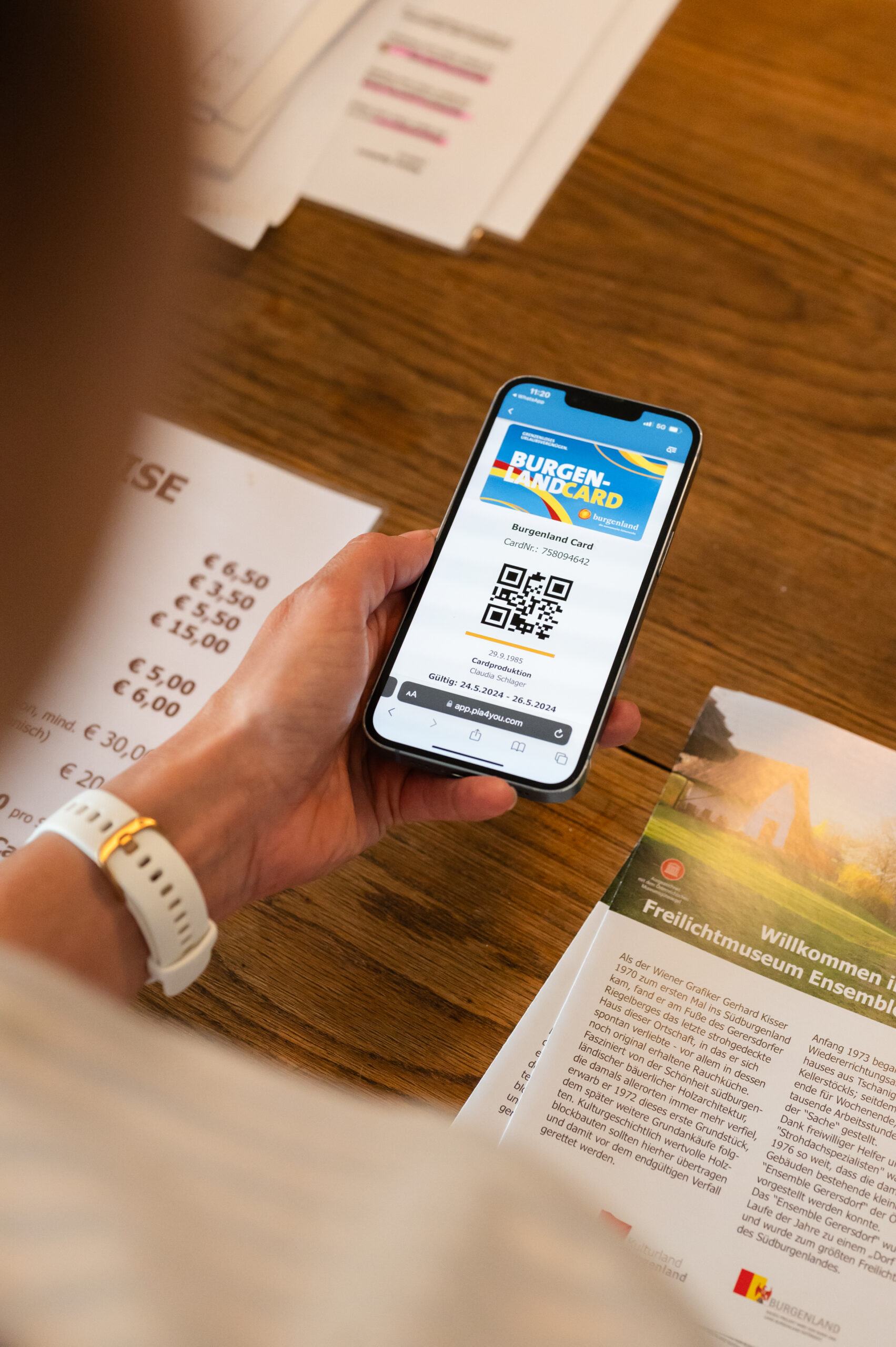
At the pension, they fill out the registration form by hand and show their passports. The Burgenland Card is printed and left on the pillow. Over the next four days, they experience the region one verification at a time: the card is scanned at the thermal spa, checked by sight at a winery, shown to the bus driver, and scanned again at the bike rental — where a paper form, another ID copy, and a cash deposit still stand between them and the ride.
By the end of the stay, they have shown their passport three times, handled two cash deposits, and repeated the same personal details at every touchpoint. The seamless “one tap” experience they know from their banking app hasn’t arrived in tourism yet.
What Burgenland Sees and Doesn’t
From the other side of the counter, the picture is just as fragmented. Burgenland Tourismus knows the family stayed — that was registered at check-in. What they did in between is mostly invisible: of five touchpoints, only two produced data. The winery’s visual check, the bus ride, and the paper-based deposit left no trace. Each partner runs its own verification, settlement, and customer record. The pension host spends roughly twenty minutes a day typing registration forms into the municipal system.
The pattern is not anecdotal. On average, an Austria vacationer experiences 7–9 separate identification or payment processes per stay, and an estimated 15–25 minutes per check-in are spent on manual verification alone. Multiplied by millions of arrivals, the avoidable effort is considerable on both sides.
Metric
Identification or payment processes per stay: 7–9
Time per manual check-in: 15–25 minutes
Touchpoints producing data (Burgenland scenario): 2 of 5
Guests feel the friction one touchpoint at a time. Destinations, businesses, and the region live with the blind spots.
Four Technologies Are Converging to Connect the Journey
What makes this moment different is that four building blocks are reaching production at the same time — and for the first time can work together:
EUDI Wallet. By end of 2026, every EU citizen will hold a digital identity wallet. Attributes — age, residency, employment, student status, language — become shareable with consent. A-Trust provides an Austrian test environment today.
Integrated payment. Mastercard is embedding tokenized payment credentials into EUDI Wallets, so a single tap can trigger both identity verification and payment. The existing POS network becomes acceptance infrastructure for verified attributes.
Guest card systems. Austria’s tourism regions run mature card infrastructures on established destination management platforms. The Burgenland Card alone reaches 60% of overnight guests.
Data infrastructure. Scan data, payment data, movement data, and consented attributes can be combined at aggregate levels — revealing usage patterns and regional value flows without tracking individuals.
Each exists today. The opportunity is in connecting them — in ways that solve frictions for guests and close blind spots for the region at the same time.
A Connected Day in Burgenland
The same family arrives in Rust. One wallet tap at check-in — registration transmitted, Burgenland Card activated, room unlocked. Over the next three days, the card works everywhere: a tap at the thermal spa (children’s admission included, no second document), a tap at the family winery that has never scanned a card before (discount applied, wine purchase settled), an anonymous signal from the bus ride, a self-releasing deposit on the bike rental.
Zero passport shows. Zero cash deposits. Zero forms. The winery got paid instantly. The bus line’s real usage is finally visible. Burgenland Tourismus has consent-based, aggregate insight into what kind of guests came and what they valued — not because more was tracked, but because the right things were shared.
The ecosystem: Your challenge partners
Mastercard operates a global payment network with over 3.3 billion cards, securing transactions between parties who don’t know each other — exactly the kind of trust gap that fragmented tourism creates. In the EUDI Wallet space, Mastercard participates in EU pilots (NOBID, WE BUILD) and is integrating tokenized payment credentials into wallets, so that a single tap can trigger both identity verification and payment authorization. The existing POS terminal network of acquiring banks can be integrated into the acceptance infrastructure. For teams, this means: you are building on real, already existing infrastructure — not on a future vision.
Burgenland Tourismus operates one of Austria’s most developed guest card systems, tying into overnight stays, public transport, thermal spas, wineries, museums, and cultural sites. Burgenland Tourismus is opening this challenge to explore what a card ecosystem for 2030 could look like — not just for guests, but for the whole region.
feratel is the technology partner behind the scenes, providing the destination management infrastructure: the MeldeClient for registration data, card issuance, and settlement between partners. What teams design on top, feratel helps make real.

Your Challenge
This challenge invites you to design not just a better guest card, but an entire digital card ecosystem for Burgenland — one that serves guests, residents, local partners, and the region on the same infrastructure.
How might we design the Burgenland Card ecosystem to create seamless experiences for guests, opportunities for residents, thriving local businesses, and value creation for the region?
Teams connect at least three consecutive touchpoints along the journey. The more coherently the steps merge into a single experience, the more convincing the prototype.
Directions to Explore
These directions are starting points, not boundaries. Pick one as your anchor — or define your own. The strongest concepts connect across several. Ideas that go beyond the obvious are explicitly welcome.
The Seamless Journey
How might we collapse identification, access, and payment into a single flow — so guests experience Burgenland instead of queuing, filling forms, or repeating themselves?
– What if check-in, registration, and card activation happened in one tap — the Burgenland Card appearing in the wallet before the room door opens?
– What if spontaneous upgrades — a Premium Pass, a wine tasting add-on, a rental upgrade — were authorized and paid in the same moment?
A Card Family, Not a Card
How might the Burgenland Card evolve from one generic product into a family of cards — tourist bundles, resident cards, employee cards, student passes, senior benefits — all running on the same infrastructure?
– What attributes and entitlements does the wallet need to carry so different card models work on one shared backbone?
– What if the ecosystem grew beyond tourism into a shared civic and commercial infrastructure for the region?
Closing the Blind Spots
How might Burgenland Tourismus understand what the card actually does — without collecting more personal data than necessary?
– What if Mastercard-linked transactions turned every redemption at visual-check partners into a consent-based data point?
– What if public transport usage — which lines, which routes, which times — became visible through consent-based wallet interactions?
Guest Value and Regional Value, Reinforcing Each Other
How might the same interaction that delights a guest also create value for the business delivering it — and for Burgenland as a whole?
– What if automated settlement flowed revenue back to small partners the moment a guest taps — no reconciliation, no manual steps?
– What if residents and employees holding their own cards turned Burgenland’s card system into a year-round ecosystem, not a seasonal one?
High-Value Use Cases: Where Transactions Matter
Beyond seamless experiences and richer data, the strongest concepts identify where payment volume actually concentrates along the journey. Different touchpoints carry very different transaction values:
– Low-frequency, high-value moments: rental cars, hotel add-ons, premium upgrades, multi-day passes, cultural event tickets.
– High-frequency, lower-value moments: spa entries, single bus rides, single bike rentals, single museum admissions.
– Spontaneous-purchase moments: wine tastings, cable car day-upgrades, dining add-ons, wellness extensions.
Where seamless identity-plus-payment removes the most friction is often where transactions also create the most economic value.
In your prototype, estimate and justify the payment volume of your use case — number of transactions × average transaction value. Identify which segments of the Burgenland journey carry the highest combined volume, where current payment friction is highest, and where Mastercard-enabled wallet payment unlocks the most economic value for guests, partners, and the region.
What’s Already Possible Today
A common question with EUDI-based concepts is how realistic they are in 1–3 years. The short answer: more is possible today than many assume.
– EUDI Wallet principles — data minimization, explicit consent, decentralized data storage — are not aspirational. They are baked into the regulation taking effect across the EU by end of 2026. Solutions designed against these principles are by default future-compliant.
– Austrian legal framework. The Meldegesetz defines what data must be collected at check-in; the Burgenländisches Tourismusgesetz governs Ortstaxe. Neither requires paper. feratel’s MeldeClient already serves as the technical interface to Burgenland’s municipalities — replacing manual entry with a wallet-based handoff is a process change, not a legal one.
– A-Trust provides a production-grade test environment for wallet applications in Austria today, allowing teams to validate concepts against actual EUDI specifications.
The constraints are real, but the playing field is broader than it looks.
What Matters: Evaluation Criteria
We are looking for convincing experiences with a clear path to implementation.
– A concrete multi-touch use case: Connect at least three consecutive touchpoints along the journey and design them as a tangible prototype.
– Notable added value: Quantify time savings, efficiency gains, and data value for guests, providers, and Burgenland Tourismus.
– Payment volume and economic value: Estimate the payment volume your use case addresses (number of transactions × average value), and show where in the Burgenland journey the highest combined volume sits.
– Seamless connection of identity and payment: Identity verification and payment chain into a single user flow — one tap, one moment.
– Effective use of AI: Show how AI creates value from consent-shared wallet attributes that wouldn’t be possible otherwise. Personalization should be transparent, temporary, and user-controlled — not profile-based.
– Regulatorily feasible: Respect EUDI Wallet principles — data minimization, consent, decentralized data storage. Reference the Austrian legal framework where it applies (Meldegesetz, Burgenländisches Tourismusgesetz). Show what’s possible within 1–3 years.
– A testable first step with the right partners: Sketch a pilot for a defined Burgenland sub-region. Name the actors who need your solution — hotels, thermal spas, wineries, mobility providers, municipalities — their incentives, and how A-Trust’s test environment could validate the concept.
What Awaits the Best Team
The winning team will receive recognition and support to advance their solution, plus a €100 My Burgenland Shop voucher for each team member to bring a taste of Burgenland home. The strongest concepts may move into pilot implementations with Burgenland Tourismus and feratel, using A-Trust’s test environment to bring ideas from prototype to reality. This is your chance to help shape a new generation of regional card ecosystems — with lessons that reach far beyond Burgenland.